

You have a fast PC, a good headset, and quick reflexes. But your connection still lags at the worst moment. That’s usually not a skill problem — it’s a network problem. Gaming corner zap internet describes a setup built around one goal: getting your gaming data to the server faster and more consistently than a normal internet plan does.
This matters whether you play on a PC, a console, in online multiplayer, or through cloud gaming. Speed alone doesn’t fix lag. Ping, latency, jitter, and packet loss all decide how smooth a match actually feels. This guide walks through what gaming corner zap internet means, how much speed you really need, and how to build a setup that keeps your connection stable when it counts.
What Is Gaming Corner Zap Internet?
Gaming corner zap internet is the idea of treating gaming traffic differently from regular internet use. A normal home connection sends a multiplayer match, a video call, and a background download through the same queue. A zap internet gaming setup separates that queue, so gaming packets move first.
This is what makes a gaming internet connection different from ordinary broadband. Six factors decide how good that connection feels in practice:
- Speed – how much data moves per second
- Latency – the delay before your action registers
- Ping – the round-trip time to the server and back
- Jitter – how much that ping number varies
- Packet loss – data that never arrives at all
- Network stability – how consistent the connection stays over time
You May Also Like It:
Droven.io Review 2026: Features, AI Tools & Complete Guide
New App Updates on Software Socials AlienSync: Latest Features & Guide (2026)
New Software Aliensync Apps Explained: Everything You Need to Know In (2026)
Why Internet Quality Matters for Gaming
Speed vs. Latency
A higher download speed does not automatically mean lower ping. Speed measures bandwidth; ping measures response time. You can have a 300 Mbps connection that still spikes to 80ms under load, because speed tests don’t measure how traffic gets prioritized.
Ping, Jitter, and Packet Loss
High ping delays every action you take. Jitter above 5ms causes inconsistent timing that throws off hit detection in shooters. Packet loss above 1% shows up as rubber-banding, where your character snaps back to an earlier position. Competitive games are far more sensitive to these three than to raw speed.
Network Stability
Frequent drops or congestion during peak hours are usually a router or Wi-Fi problem, not a speed problem. A stable connection matters more for a smooth session than a faster one that dips unpredictably.
How Much Internet Speed Do You Need for Gaming?
Most online games use surprisingly little bandwidth. A stable 20 to 50 Mbps connection handles the majority of multiplayer titles without trouble.
Upload speed
matters more than people expect — it affects how quickly your inputs reach the server and is essential for streaming your gameplay at the same time.
Is 100 Mbps enough for gaming?
Yes, for a household with a few devices and one active gamer. It becomes tight only when several people are streaming, downloading, or gaming at once — that’s when a higher tier or better routing helps more than raw speed alone.
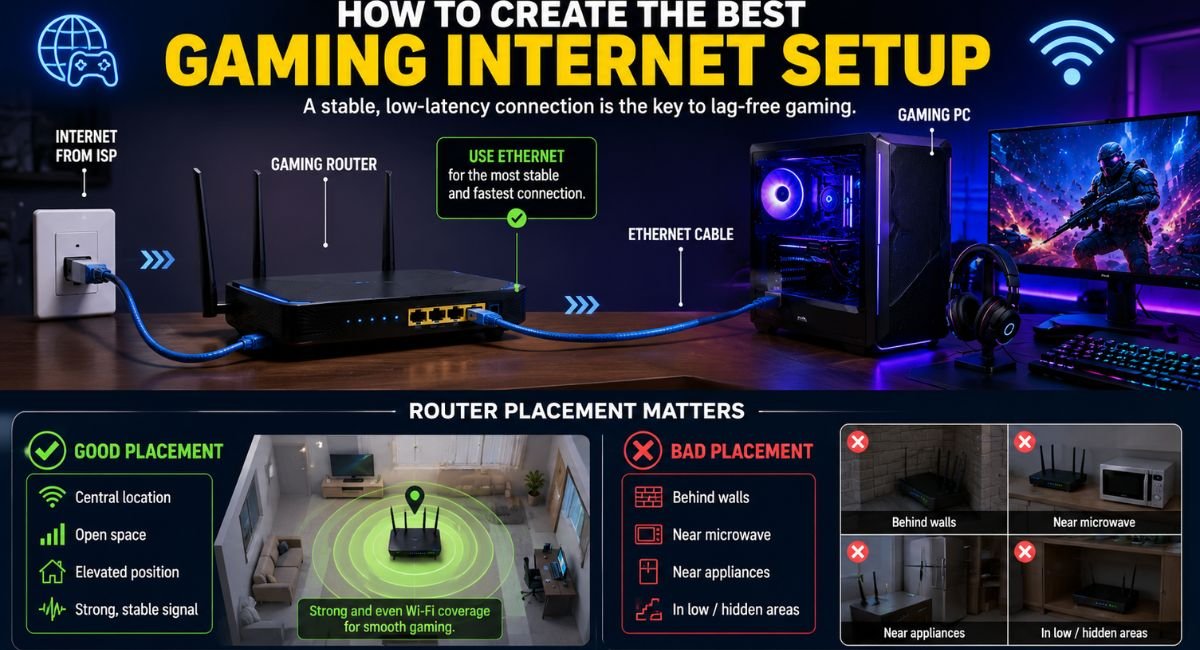
How to Create the Best Gaming Internet Setup
Choose a stable connection type
Fiber offers the most consistent latency; cable is a solid second option.
Use Ethernet for gaming
A wired connection removes the interference Wi-Fi introduces, even on a strong signal — this is the single biggest upgrade most gamers can make.
Optimize your gaming router
Place it centrally, away from microwaves and thick walls. Turn on Quality of Service (QoS) and set your gaming device as the highest priority so its packets don’t wait behind a software update.
Wi-Fi 6 vs. Wi-Fi 7 for gaming
if Ethernet isn’t possible, both standards cut latency noticeably in device-heavy homes. Wi-Fi 7 pushes this further but matters most when several people are online at once.
How to Reduce Ping and Gaming Lag
- Use Ethernet wherever possible
- Sit closer to the router if you must use Wi-Fi
- Pause downloads and uploads before a match
- Restart or update your router regularly
- Pick the closest available game server
- Close background apps and cloud backups
- Run a quick ping test to check for packet loss or jitter
Wi-Fi vs. Ethernet for Gaming
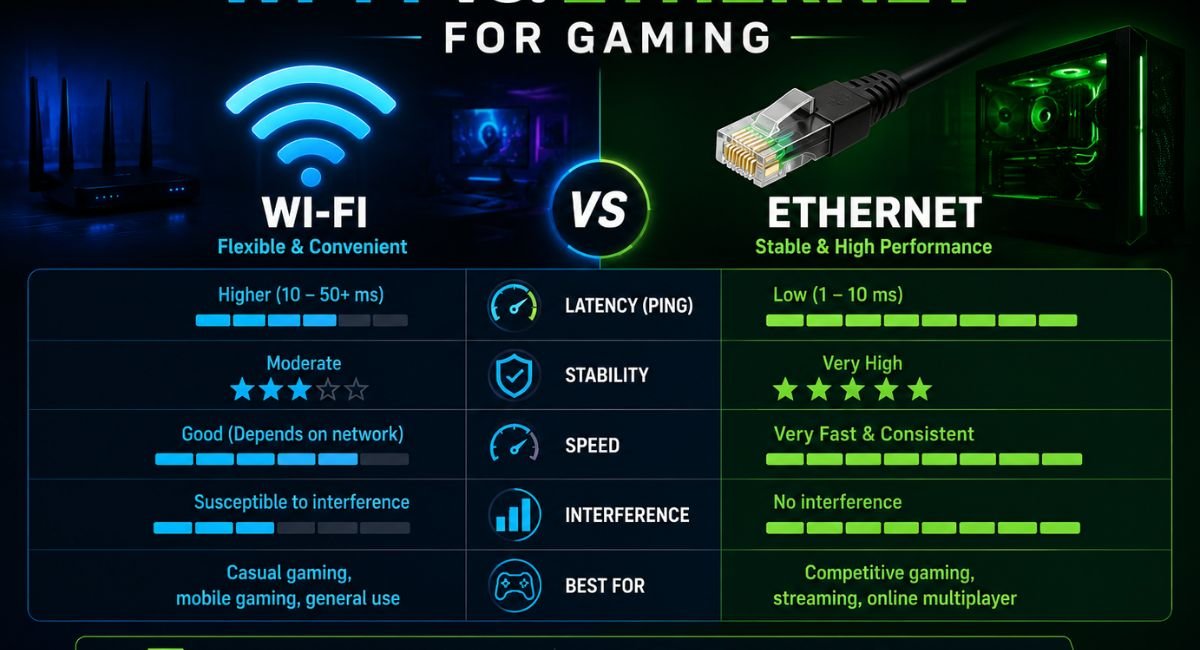
| Factor | Wi-Fi | Ethernet |
|---|---|---|
| Convenience | High | Moderate |
| Stability | Variable | Excellent |
| Latency | Can vary | Usually lower |
| Mobility | Excellent | Limited |
| Competitive gaming | Depends on setup | Preferred |
Best Internet Setup for Different Types of Gamers
PC gaming benefits most from a wired connection paired with QoS, since PCs run more background processes that can compete for bandwidth.
Console gaming (PS5, Xbox, and similar) performs best on Ethernet too — most consoles ship with a port for exactly this reason.
Multiplayer gaming depends on consistent latency more than peak speed, since every player’s input timing has to stay in sync with the server.
Cloud gaming is the most demanding case. Because the game runs on a remote server and streams back to you, even 40–50ms of ping can noticeably soften image quality and delay input.
You May Also Like It:
Droven.io Review 2026: Features, AI Tools & Complete Guide
New App Updates on Software Socials AlienSync: Latest Features & Guide (2026)
New Software Aliensync Apps Explained: Everything You Need to Know In (2026)
Common Gaming Internet Problems and Fixes
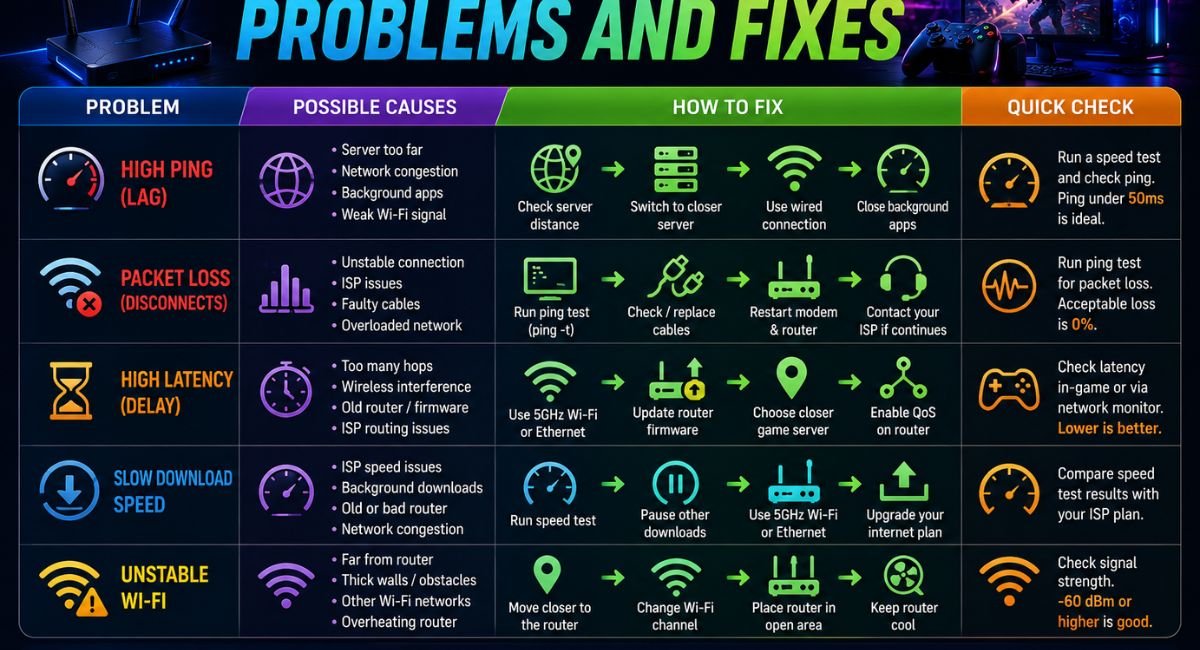
High ping — usually server distance or congestion; switch to the nearest server first. Random lag spikes — often other devices on the network; enable QoS and close background apps. Packet loss — run a ping test or traceroute to find where data is dropping, then check your cabling or router. Slow download speed — check for other active downloads or too many connected devices. Unstable Wi-Fi — move closer to the router or switch to Ethernet. Connection drops — usually outdated firmware or a weak signal; update the router and consider a wired link.
Does Faster Internet Reduce Ping?
Not directly. Ping depends on routing and distance to the server, not on bandwidth. If your current speed is already enough for gaming, upgrading further rarely lowers ping — what helps is better routing, QoS prioritization, or a wired connection instead of a faster plan.
Gaming Corner Zap Internet: Best Practices for Low-Lag Gaming
- Choose fiber or another reliable connection type
- Use Ethernet for competitive play
- Keep router firmware updated
- Minimize background traffic during sessions
- Monitor ping and packet loss regularly
- Optimize Wi-Fi placement if wired isn’t an option
- Pick the nearest game server
- Test connection stability, not just speed
Frequently Asked Questions
What internet speed is good for gaming?
20–50 Mbps handles most games; higher tiers help mainly with multiple users or streaming.
Is 100 Mbps enough for gaming?
Yes, for typical single-household use.
Does faster internet reduce ping?
Not usually — ping depends on routing and distance, not bandwidth.
How can I reduce ping in online games?
Use Ethernet, pick the nearest server, and enable QoS on your router.
Is Wi-Fi good enough for gaming?
It can work, but it’s less consistent than Ethernet, especially in busy households.
Is Ethernet better than Wi-Fi for gaming?
Yes — it offers lower and more stable latency.
What causes lag while gaming?
High ping, jitter, packet loss, or network congestion.
How do I fix packet loss?
Run a ping test or traceroute, then improve your connection path or switch to a wired setup.
What router is best for gaming?
One with strong QoS support and enough throughput for your household’s device count.
How much latency is good for gaming?
Under 30ms for fast-paced shooters; up to 60ms is fine for racing or strategy games.
Final Verdict
A good gaming corner zap internet setup isn’t about chasing the highest speed number. Low latency, stable connectivity, minimal jitter, and near-zero packet loss matter more for how a match actually feels. Start with a wired connection, tune your router’s QoS settings, and pick servers close to you — that combination solves most lag problems before a speed upgrade ever needs to.
You May Also Like It:
How Many Missions Will GTA 6 Have? Story Mission Count, Campaign Length & Gameplay Guide (2026)
Does Instagram Notify When You Screenshot Someone’s Story? (2026 Truth Explained)
Connectivity HSSGamepad: Ultimate Setup & Fix Guide (2026)

1 thought on “Gaming Corner Zap Internet: Complete Guide to Faster, Low-Lag Gaming(2026)”